
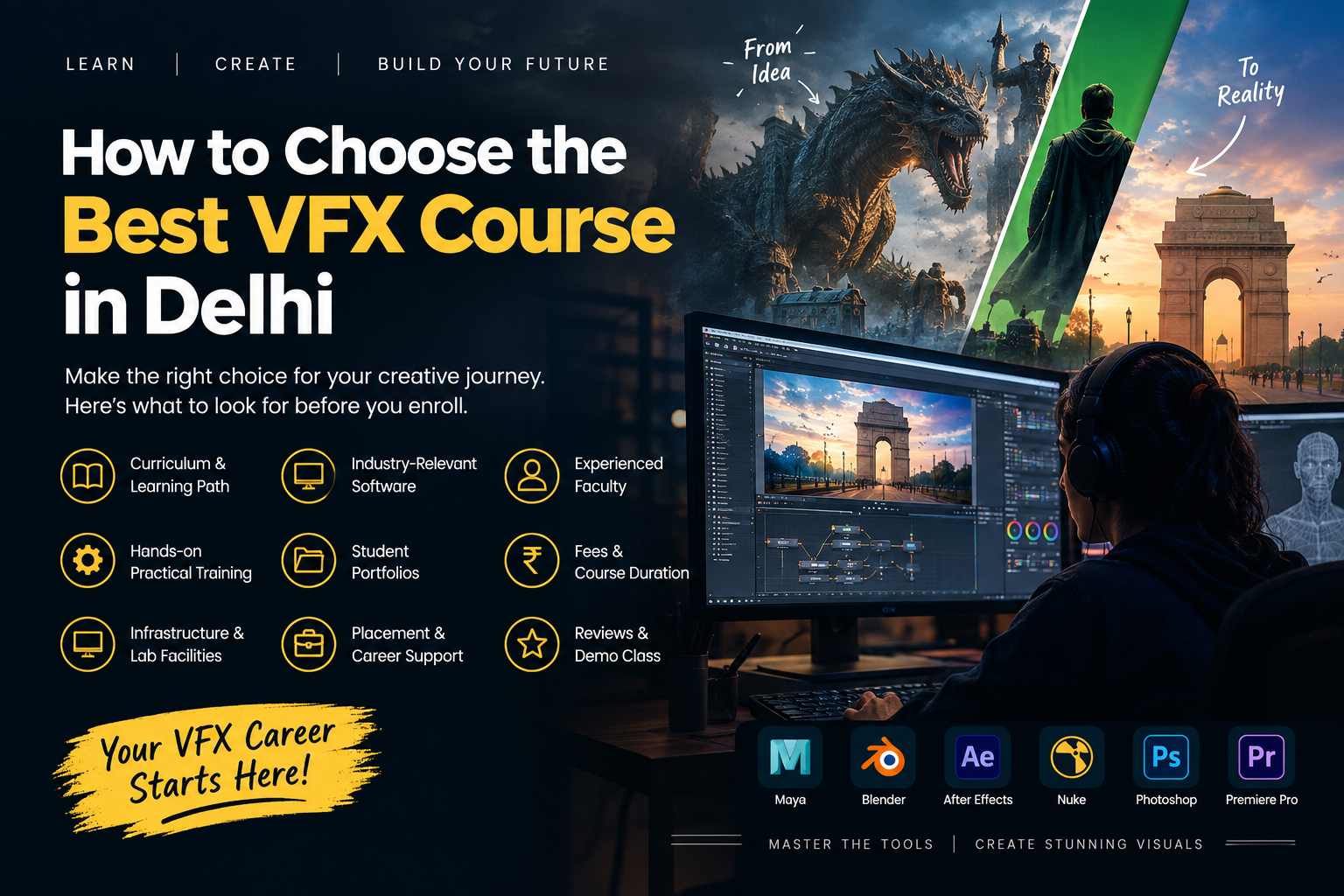
If you are interested in visual effects and want to build a career in the film, television, advertising, gaming, or digital media industry, choosing the right VFX course in Delhi is an important first step. Delhi has many institutes offering VFX training, but every course is different in terms of syllabus, software, faculty, practical training, fees, and placement support.
Choosing a course only because it is affordable or popular may not always give you the skills you need. Before enrolling, you should compare different institutes and understand what each course actually offers.
Here are some important factors to consider when choosing the right VFX course in Delhi.
1. Check the Course Curriculum
The first thing to check is the syllabus. A good VFX course should cover the basic concepts as well as advanced techniques used in the industry.
Depending on the course level, you may learn areas such as:
- Compositing
- 2D and 3D animation
- 3D modelling
- Texturing
- Lighting
- Rotoscoping
- Match moving
- Motion graphics
- Green screen and chroma keying
- Visual effects creation
- Video editing
Before joining a VFX course in Delhi, compare the curriculum of different institutes. Make sure the course teaches practical skills rather than focusing only on theory.
2. Look at the Software You Will Learn
VFX professionals work with different software and tools. Therefore, the software included in your course is an important factor.
A good VFX program may provide training in software such as:
- Adobe After Effects
- Adobe Premiere Pro
- Autodesk Maya
- Blender
- Nuke
- Photoshop
- Cinema 4D
- Houdini
You do not necessarily need to learn every software available. What matters is whether the course teaches the tools relevant to your chosen career path.
For example, someone interested in compositing may need strong knowledge of Nuke and After Effects, while someone interested in 3D modelling may need to focus more on Maya or Blender.
3. Check the Experience of the Faculty
Teachers play an important role in your learning experience. Before choosing a VFX course in Delhi, research the instructors and their professional backgrounds.
Experienced instructors can explain industry workflows and provide practical guidance based on real projects. Check whether the faculty members have experience in areas such as films, advertising, animation, gaming, or post-production.
You can also look for student reviews to understand how effectively the faculty explains concepts and helps students during practical assignments.
4. Focus on Practical Training
VFX is a skill-based field, so practical training is extremely important. Simply watching lectures or learning software features is not enough.
A good VFX course in Delhi should give students opportunities to work on practical projects. These projects can help you understand how different VFX techniques are used in real production environments.
For example, students could work on:
- Short films
- Green-screen projects
- 3D scenes
- Motion graphics
- Compositing projects
- Product advertisements
- Character or environment projects
Practical assignments also help you create work that can eventually become part of your portfolio.
5. Review Student Portfolios
One of the easiest ways to understand the quality of a VFX institute is by looking at the work produced by its students.
Ask the institute to show you student portfolios, showreels, or completed projects. Pay attention to the quality and complexity of the work.
You can ask yourself:
- Does the work look professionally made?
- Are students working on different types of projects?
- Does the work demonstrate technical skills?
- Are the projects original?
- How much improvement do students show during the course?
A strong student portfolio can indicate that the institute provides useful practical training.
6. Compare Course Duration and Fees
VFX courses can range from short-term programs to longer diploma or degree-level courses. The right duration depends on your current knowledge and career goals.
If you are a complete beginner, a longer course may give you more time to understand the fundamentals and develop advanced skills. If you already know the basics, a shorter specialized course may be more suitable.
When comparing fees, do not look only at the total amount. Check what is included in the fee.
For example:
- Software training
- Practical projects
- Certification
- Lab access
- Portfolio development
- Workshops
- Career guidance
- Placement assistance
This will help you understand the actual value of the course.
7. Check the Infrastructure and Lab Facilities
VFX work requires computers capable of handling demanding software and large project files. Before enrolling, visit the institute if possible and check its infrastructure.
Look at the computer specifications, software availability, lab facilities, and classroom environment.
You should also check whether students get enough time to practice independently. Having access to proper systems and software can make a significant difference in your learning experience.
8. What to Look for in a VFX Course in Delhi
Your skills matter, but your portfolio is what allows potential employers or clients to see those skills.
A good VFX course in Delhi should help you develop a professional portfolio and showreel by the end of the program.
Your showreel should demonstrate your strongest work and relevant technical abilities. Instead of including every project you have created, it is generally better to present selected projects that represent your best skills.
Ask the institute whether portfolio development is included in the course.
9. Look for VFX Career and Placement Support
If your main goal is to get a job after completing the course, investigate the institute’s placement support carefully.
Do not rely only on statements such as “100% placement assistance.” Ask specific questions about:
- Companies that recruit students
- Types of job roles available
- Internship opportunities
- Interview preparation
- Resume support
- Portfolio guidance
- Previous student placements
Placement assistance and actual job placement are not necessarily the same thing, so understand exactly what the institute provides.
10. Compare VFX Course in DelhiFees and Duration
Online reviews can give you an idea about the student experience, but do not depend on ratings alone.
Look for detailed reviews discussing:
- Teaching quality
- Faculty support
- Practical training
- Infrastructure
- Course content
- Placement assistance
- Overall learning experience
If possible, speak directly with current or former students. They can provide practical information that may not be available on an institute’s website.
11. Choose a Specialization Based on Your Career Goal
VFX is a broad field. Before selecting a course, think about which area interests you the most.
Some possible career paths include:
- VFX Compositor
- 3D Artist
- 3D Modeller
- Lighting Artist
- Rotoscopy Artist
- Matchmove Artist
- Motion Graphics Artist
- VFX Generalist
- 3D Animator
You do not need to have your entire career planned before starting, but having a general direction can help you choose a suitable VFX course in Delhi.
What to Look for in a VFX Course in Delhi
If an institute offers a demo class or counselling session, take advantage of it.
A demo class can help you understand the teaching style, classroom environment, software training, and level of practical instruction.
You can also use this opportunity to ask questions about the syllabus, projects, faculty, fees, and career opportunities.
Choosing the Right VFX Course in Delhi
Choosing the right VFX course in Delhi requires more than comparing course fees or institute names. You should evaluate the curriculum, software training, faculty experience, practical projects, infrastructure, student portfolios, course duration, and career support.
Before making your decision, compare at least two or three institutes and carefully understand what each course provides. Most importantly, choose a program that gives you practical experience and helps you build a strong portfolio.
A good VFX education should not only teach you how to use software but also help you understand the creative and technical workflow used in professional VFX production. With the right training, consistent practice, and a strong portfolio, you can build the skills needed to explore opportunities in the growing visual effects and digital media industry.